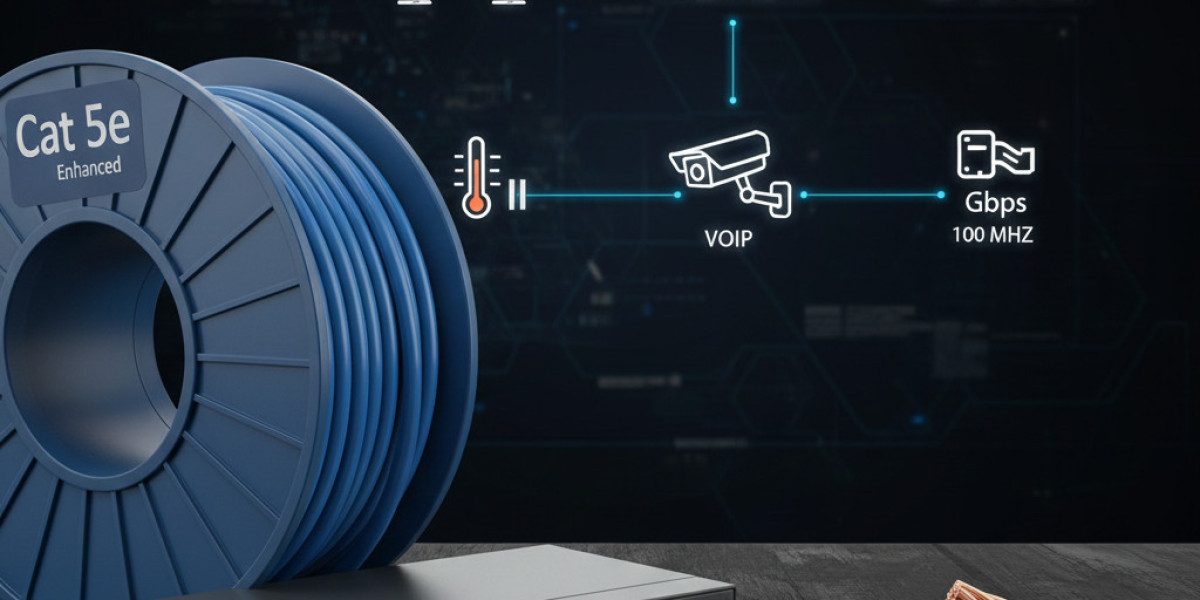

When setting up a home or office network, choosing the right Ethernet cable plays a big role in getting stable and high-speed performance. Among the popular options, Cat5e cables are widely used because they are reliable, affordable, and support gigabit speeds. While people often focus on speed ratings, one important but less-discussed factor is the wire gauge. The wire gauge determines how thick the copper conductor is inside the cable, and it affects everything from durability to signal quality. So, what wire gauge is typical in Cat5e, and why does it matter?
The typical wire gauge used in Cat5e (Category 5 Enhanced) cables is 24 AWG. AWG stands for American Wire Gauge, which is a standardized system that measures the thickness of wires. The lower the AWG number, the thicker the wire. Because of this, 24 AWG wires strike a balance between performance and flexibility, making Cat5e a practical choice for everyday networking needs.
Before understanding why 24 AWG is so common, it’s helpful to know how wire gauge impacts a cable’s capability. Thicker wires allow signals to travel longer distances with less resistance. Thinner wires are easier to bend and install but may not perform well over extended runs. Since Cat5e is designed for both home and commercial environments, manufacturers use 24 AWG to deliver consistent performance without making the cable too bulky.
Another important element in Cat5e wiring is whether the cable uses solid copper conductors or stranded conductors. Solid copper means each wire inside the cable is a single solid piece of copper, while stranded conductors consist of multiple thin copper strands twisted together. Solid 24 AWG conductors are common for fixed installations such as walls and ceilings. Stranded 24 AWG conductors are more flexible, making them ideal for patch cables that connect devices like routers, switches, or laptops.
The AWG size also influences how far a cable can carry data. Cat5e cables can support gigabit speeds over distances up to 100 meters (328 feet), but this performance depends on the conductor size and quality. Using the recommended 24 AWG helps maintain signal strength across that full distance. If the wire gauge were thinner, such as 26 AWG or 28 AWG, signal loss (attenuation) would increase, especially at longer runs. This is why higher AWG numbers are usually found only in ultra-thin patch cables, not full-length runs.
It’s also important to understand that modern networks include many different cable categories. While Cat5e is still widely used and reliable, newer categories like Cat6, Cat6a, and Cat8 offer higher speeds and bandwidth. These modern cables sometimes use thicker conductors such as 23 AWG to support their faster data transmission. Learning about the different types of networking cables helps you decide which category and gauge fit your specific needs.
Cat5e cables are usually designed with unshielded twisted pairs (UTP), although shielded versions (STP) are available for environments with heavy electrical interference. The wire gauge remains the same—24 AWG in most cases—whether the cable is shielded or unshielded. The shielding does not affect conductor thickness but simply protects the signal from outside noise.
When shopping for Cat5e cables, you may also come across CCA (Copper-Clad Aluminum) instead of pure copper conductors. While they still use a 24 AWG size for the conductor, the internal material is different. CCA cables have higher resistance, lower durability, and cannot perform as well as pure copper, especially for Power over Ethernet (PoE). If you plan to power devices like IP cameras or access points through the cable, choosing 24 AWG pure copper Cat5e is essential for safety and performance.
Another reason the 24 AWG size is ideal is because it supports the twisting structure used in Cat5e cables. Each pair of wires inside the cable is twisted together to reduce crosstalk and maintain signal clarity. The combination of twist rate and 24 AWG thickness ensures a strong signal balance, which is crucial for maintaining gigabit performance. Thicker conductors may become too stiff, while thinner conductors may lack the strength to handle long-distance data transmission.
Installation also becomes easier with 24 AWG Cat5e cables. They are neither too thick to bend around corners nor too thin to break easily. For networking technicians or DIY installers, this makes Cat5e a practical option. Whether you’re wiring an entire office or simply connecting your Wi-Fi router to a computer, the flexibility and reliability of 24 AWG cables save time and effort.
Another factor to consider is heat dissipation. Thicker wires can carry electrical signals with lower resistance, which results in less heat generated inside the cable. This is especially important when running multiple cables in a bundle. A cable with the standard 24 AWG size handles heat better compared to thinner cables, helping maintain performance and safety.
Cat5e cables with 24 AWG conductors are also perfectly suited for PoE applications. Power over Ethernet allows a single cable to deliver both power and data to devices like IP cameras, VoIP phones, and wireless access points. Using the recommended wire gauge ensures the cable can safely carry the electrical current without overheating or losing performance. Again, this is where choosing pure copper makes a big difference.
As newer cable categories continue to grow in popularity, Cat5e still remains one of the most cost-effective options for gigabit networks. It offers great performance for most households and many small offices. Understanding the typical wire gauge helps you choose a good-quality cable instead of just buying the cheapest one available. When you know that 24 AWG pure copper conductors are standard and reliable, you can make an informed choice.
In summary, the typical wire gauge used in Cat5e cables is 24 AWG, and it plays a key role in the cable’s performance, flexibility, and durability. Whether the cable is solid or stranded, shielded or unshielded, this gauge ensures a balance between strong signal transmission and easy installation. If you’re comparing different types of networking cables, knowing the wire gauge helps you understand why Cat5e remains a popular and dependable option.
Choosing the right cable starts with knowing what’s inside it. The 24 AWG conductors used in Cat5e are designed to support gigabit speeds, handle PoE applications, and maintain performance across long distances. As long as you select pure copper Cat5e cables from trusted brands, you can expect reliable connectivity for your home or business network.
Sources: https://www.webtrafficexchange.com/applications-and-work-principles-of-cat-5e-ethernet-cables
https://connect.usama.dev/blogs/55330/UTP-or-STP-Which-Cat-5e-Variant-to-Choose